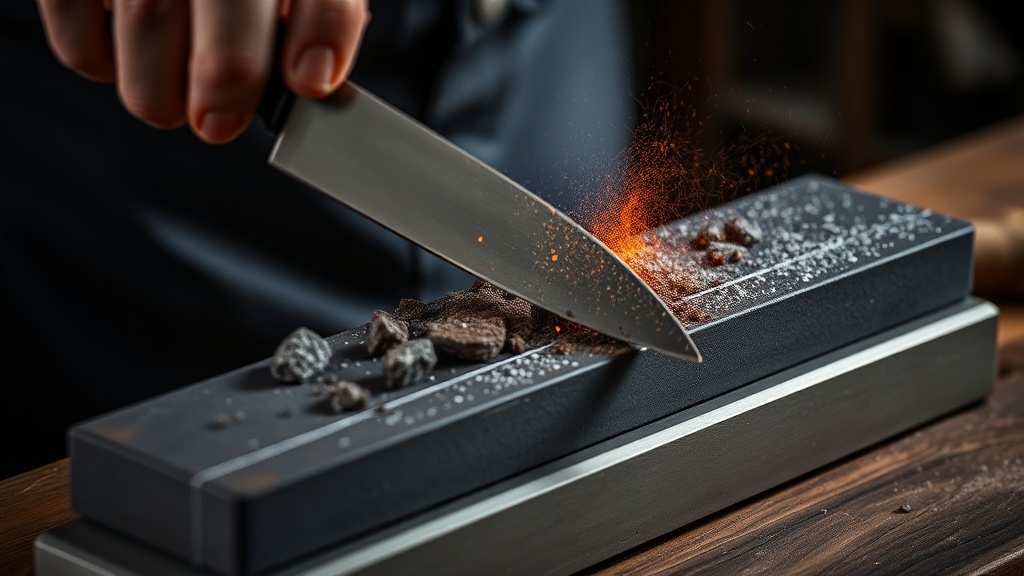
How to Sharpen a Dull Knife Using a Whetstone

You'll learn how to transform a dull, struggling knife into a precise cutting tool using nothing more than water and a whetstone. Unlike honing—which only realigns an existing edge and won't help a truly dull blade—sharpening removes a thin layer of metal to create an entirely new, keen edge. Getting this right saves you money on professional sharpening services (typically $5-10 per knife) and makes cooking safer and more enjoyable. Whether you're working with a $20 Victorinox Fibrox or a $200 handmade Japanese gyuto, the technique remains fundamentally the same. This guide covers everything from stone selection to maintaining that perfect 15-degree angle, plus troubleshooting when things don't go as planned.
How Do I Know When My Knife Actually Needs Sharpening?
Many home cooks confuse honing with sharpening—and it's costing them both money and fingertip safety. Honing steel (that rod that came with your knife block) or a ceramic rod realigns a bent edge back to center, which helps a relatively sharp knife cut better temporarily. But when the edge has actually worn down—when microscopic teeth have broken off or rounded over through contact with cutting boards, bones, or ceramic plates—no amount of honing will restore performance. You're just straightening a worn-out edge.
Test your knife on a sheet of printer paper held vertically in your non-dominant hand. A sharp blade slices through cleanly without snagging, tearing, or requiring a sawing motion. Next, try cutting a ripe tomato with just the weight of the blade; sharp knives bite in immediately and glide through with minimal pressure, while dull ones slide off the skin or crush the flesh rather than slicing it. Finally, examine the edge under bright light—if you see a reflective line or glare along the cutting bevel, that's a rounded, dull edge. If your knife fails these tests and five strokes on a honing rod doesn't improve performance significantly, it's time to break out the whetstone.
What Grit Whetstone Should I Buy First?
Whetstones come in various grit ratings—those numbers like 1000, 3000, or 8000 that indicate abrasive particle size measured in microns. For routine maintenance and restoring an edge to a merely dull knife that's been maintained reasonably well, a 1000-grit stone suffices perfectly. This "medium" grit removes enough metal to create a fresh edge without grinding away excessive blade material or taking all afternoon.
If your knife has visible chips, nicks, or has gone years without proper sharpening, start with a coarser 400 or 600 grit to repair the edge geometry quickly, then progress to 1000 to refine the scratch pattern and create a clean apex. Polishing stones—3000 grit and higher—create a mirror finish and extreme sharpness but aren't strictly necessary for home cooking. Many beginners sensibly opt for a combination stone (typically 1000/6000 grit) which offers versatility without cluttering the drawer or emptying the wallet. Pay attention to stone type, too. Traditional soaking stones (like those from Naniwa or Suehiro) need 10-15 minutes submerged in water before use—they release abrasive slurry during sharpening that helps cut efficiently. Splash-and-go varieties (Shapton Glass, Naniwa Pro) work immediately with just a sprinkle of water and are convenient for quick touch-ups, though they tend to wear faster and cost more. Neither type works well with oil once you've used water on them—so commit to one lubricant and stick with it.
How Do I Maintain the Correct Angle While Sharpening?
Here's where most beginners falter—consistency matters more than achieving a mathematically perfect angle. Most Western-style chef's knives (Wüsthof, Henckels, Sabatier) use a 20-degree angle per side; thinner, harder Japanese knives (Shun, Miyabi, or hand-forged carbon steel blades) typically call for 15 degrees or even less. You don't need a protractor or angle gauge resting on your counter. Instead, use the coin trick: rest your blade on the stone, place two pennies under the spine for a 15-degree guide (or three pennies for 20 degrees on thicker German knives), note the height and wrist position, then remove the coins and maintain that relationship by feel.
Place the heel of the knife at the stone's far edge, tip pointing up and slightly toward you. Using moderate pressure—about the force you'd use to slice a firm carrot or the weight of the knife plus a gentle push—slide the blade across the stone in a sweeping arc, moving from heel to tip as you push forward and down. Think of shaving a thin slice off the stone itself, or trying to slice the top layer off a stick of butter. Complete 10-15 strokes, then flip the knife and repeat on the other side. Periodically check for a burr—a rough lip of metal that forms on the opposite edge when you've ground one side sufficiently. Feel for it by running your fingertip perpendicular to the blade (never along it—safety first, always) or by gently dragging the edge across a cork or your thumbnail. Once you feel a consistent burr from heel to tip, you know you've reached the apex. Switch to the other side and create a burr there too. This verifies that you've actually sharpened all the way to the edge, not just polished the sides.
Why Is My Knife Still Dull After Twenty Minutes of Work?
If you've been grinding away with no improvement, you're likely committing one of several common errors. First, check your grit progression—if you start with a 6000-grit stone on a truly dull knife, you'll polish the bevels without actually creating a new edge. It's like waxing a car with no paint underneath. Start coarse enough to actually reshape the steel, progress through finer grits only after establishing the edge, and finish by removing the burr completely. Another frequent mistake involves angle consistency. Lifting the heel or dropping the tip during the stroke rounds the edge rather than sharpening it—your knife edge should contact the stone at a consistent angle along the entire length.
Some people also forget to form a burr before switching sides. Without that burr, you haven't ground the steel all the way to the apex of the edge. You might have polished the sides beautifully while leaving the actual cutting edge rounded and dull. Be patient—on a very dull knife or hard steel, creating that first burr might take 50 strokes. Don't switch prematurely. Finally, check your stone's condition. A glazed stone (loaded with metal particles) cuts poorly. If your stone feels smooth and slippery rather than abrasive, it needs cleaning—scrub it with a nagura stone, a piece of coarse sandpaper, or even a drywall screen to expose fresh abrasive particles. For detailed technique guidance, Serious Eats offers an excellent visual guide, and Cook's Illustrated has tested reviews of various stones.
How Do I Keep My Whetstone in Good Condition?
A dished, uneven stone creates uneven edges—it will hollow out the middle of your knife over time. After every few sharpening sessions, check your stone's flatness by laying a straightedge or ruler across the surface in several directions. If you see gaps underneath or the stone rocks, it's time to flatten. Most manufacturers sell dedicated flattening plates or coarse diamond stones for this purpose. Budget-conscious cooks use drywall sanding screen (80-120 grit) mounted on a perfectly flat piece of granite tile or thick glass—cheap and surprisingly effective. Korin Japanese Trading provides excellent resources on stone maintenance specific to Japanese water stones.
Store stones in a cool, dry place away from direct sunlight. While soaking stones won't be chemically damaged by water, they can grow mold or develop cracks if stored damp in dark drawers—especially in humid climates. Let them dry completely on a rack or standing on end before putting them away. Never leave them submerged in water for days; the binder can soften and the stone can crack as it dries unevenly. If you own multiple stones, consider building a sharpening station—a dedicated space with a towel underneath to catch water, a container for soaking, and good lighting. Sharpening is meditative once you get the hang of it (there's a reason chefs find it calming after a busy service), and having everything ready encourages regular maintenance rather than procrastinating until your knives are dangerously dull.
A sharp knife doesn't just make cooking faster—it makes it fundamentally safer. Dull blades require excessive force, slip more easily on resistant surfaces like tomato skins or onion peels, and cause significantly worse injuries when accidents inevitably happen. The time you invest—twenty minutes with a whetstone every few months, thirty seconds with a honing steel weekly—pays dividends in precision, enjoyment, and safety. Start with that tomato test, grab your stone from the drawer, and feel the immediate difference a truly sharp edge makes the next time you prep dinner.